Itsukushima shrine in Aki No Miyajima | HOTEL MIYARIKYU

Access

Q&A

The world cultural heritage Itsukushima shrine

The history and background of Itsukushima Shrine

Great antiquity,People felt the aura in Miyajima. People made the mountain etc. the object of the belief. It is told that it was created in 593 years.
1168 years,Tairanokiyomori made the basis in present Itsukushima Shinto Shrine.


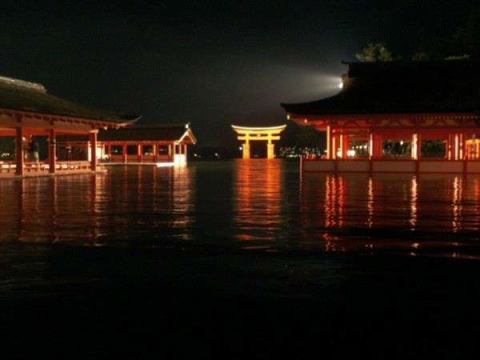
It is built on the sea, and another doesn't have the spectacle that combines with the mountain of the background. It is the one by the idea of Tairanokiyomori. The Heian era,this is typical of showing his achievement. Moreover, this is a cultural heritage that shows the history of the syncretization of Shinto with Buddhism of Japan.


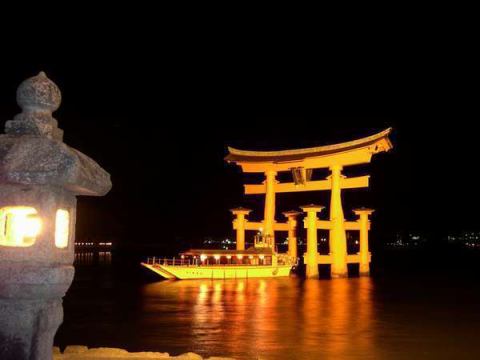
Ohtorii (National Important Cultural Property)

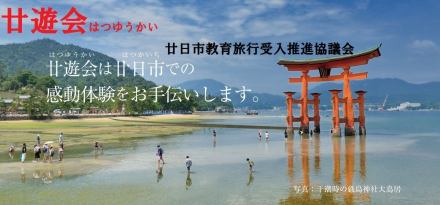
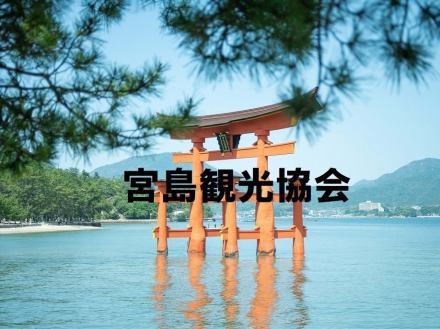
Ohtorii in Itsukushima Shinto Shrine is a representative of the sightseeing of Japan.
It is known to the foreign country. The foot of the torii is four. In the record, there was a torii for a long time. However, shape is uncertain. A torii today is the eighth generation.


Honden (Main Sanctuary) (National treasure / The Heian period)

Deities enshrined: Ichikishimahime-no-mikoto, Tagorihime-no-mikoto, Tagitsuhime-no-mikoto 

It is length of the main shrine.
The front is about 14.4 meters.
The back is about 16.2 meters.
The feature of the main shrine is not a standard tree in the Shinto shrine.
A present Shinto shrine is the one rebuilt by Motonari Mori in 1771.


Hirabutai (flat stage) (National treasure / The Heian period)

It is a balcony in front of the Shinto shrine. The area is 167.6 tsubos. There is a place that is called before the fire scorch forward. The wind and stringed instruments festival is held here. The contrast with a vivid green of mountains in vermilion Ohtorii and a blue sea and the opposite bank is wonderful. And, I feel standing on the sea. There are 239 tstone poles in total here together with Hitasaki pier


Takabutai (high stage) (National treasure / The Heian period)

It is a stage at the center of a Hirabutai. The present one is construction in 1546.
1573 - 1591 year was a type of assembly that was assembled whenever there was court dance and music and put on the center of a flat stage. It is said that it became the current shape in year of 1615 - 1623 afterwards. As the stage, it seems to be the minimum one.


Noh play (National Important Cultural Property / Edo period)

Noh play has been built on the sea. Therefore, there is no container usually put under Noh play to resonate. The floor becomes like one board. This is because it is Noh stage on the sea.